What Steam-Bending Does to Wood (and Why It Matters)
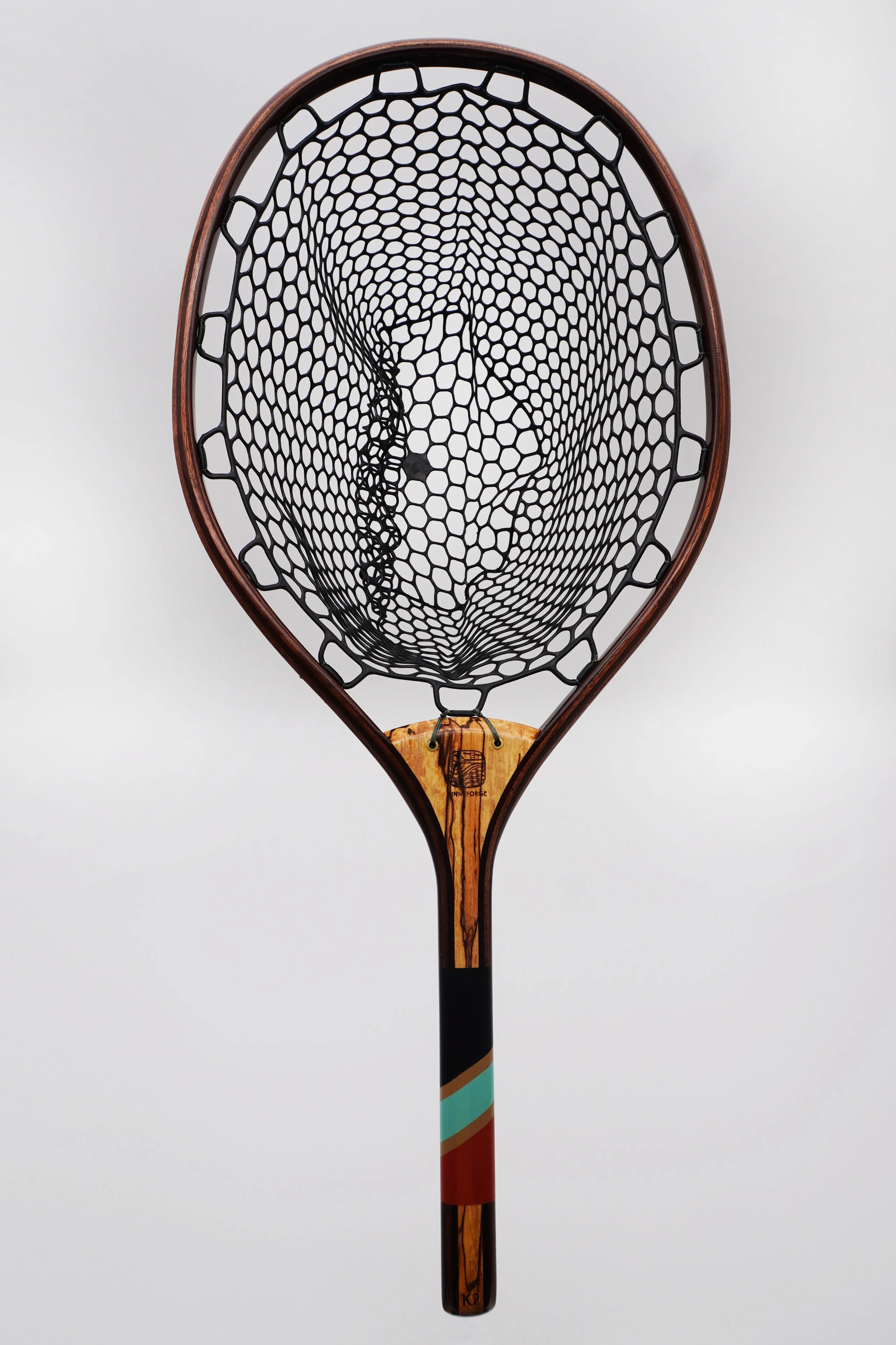
How most nets are built
Most wooden landing nets get their hoop the fast way. Two long strips bent cold around a form, no steam, glued into a curve, with a core drawn on a board and cut out on a bandsaw. That works, sort of. But a cold bend is a fight the wood never agreed to, and a bandsawn core severs fibers right where the frame takes its beating: the bow, where a thrashing trout slams into it and where it smacks the rocks when you fumble it. That is where wood breaks.
How I build mine
I bend my frames instead of cutting them. I hand-select every board for the grain I want, and it has to be knot-free. Then I plane it down to 3/4 inch myself and rip 1/8 inch thick strips, 68 inches long or longer, using my Woodpeckers thin rip guide. Each strip steams for about an hour until the lignin goes fully pliable, then it goes into the mold to take the bend and sits 14 to 18 hours. Then I cut the core out of a solid piece of hardwood, bend the strips around it, and glue the whole thing together. After that I shape the handle by hand.
What the steam does
Here is what is going on in there. Wood is cellulose fibers glued together by lignin, a natural resin. Dry, that glue is stubborn. But heat plus moisture softens it without hurting the fibers, and for a little while the wood goes plastic. The fibers can slide past each other. You can bend a strip that would snap in half cold.
Then I let it cool and dry in the form. The lignin hardens back up, locked into the new shape. The wood is not being held in a curve. It has learned the curve. That is the whole trick, and it is why a steam-bent hoop is stronger than the board it came from. The grain runs unbroken all the way around, so when a fish surges sideways the load travels along the fibers, the direction wood is strongest. No cut ends, no weak spot at the bend.
There is one more thing the bend does. The inside of the curve compresses as it bends, so the wood ends up a little denser right at the bow. Denser means it dents less, and for a net that lives in the water it means fewer open paths for water to work in.
Bent is not the same as steam-bent
Now, bent does not always mean steam-bent, and the distinction matters. In those cold-bent strips the lignin was never softened, so it never reset. The only thing holding the curve is glue, and the fibers are under tension the whole time, trying to spring back straight. Every trip in and out of the water works those glue lines a little more. After a few seasons the strips start lifting, the bend starts splintering, and one day the frame lets go. The wood never agreed to the curve. Steam-bending asks it first.
What steam cannot do
I should be honest about what steam cannot do, too. It will not make a soft wood hard. It will not waterproof anything. And it cannot save bad stock. A strip with wild grain will crack in the bend no matter how good the steam is.
The finish
And steam does not protect against water. That is the finish's job, entirely. My frames get a coat of tung oil on bare wood, then about seven coats of Epifanes marine polyurethane, sanded between coats. It is the same spar varnish they put on boat brightwork. It builds a thick skin that flexes with the wood instead of cracking.
Taking care of it
Taking care of it is on you, not me. Rinse the net, let it dry. When the varnish starts looking thin, usually where it kisses rocks and gunnels, scuff it lightly with 220 grit and lay on a fresh coat or two. Do that and the finish will outlast the net bag. Just do not oil over the varnish. Oil cannot get through a film finish. It sits on top, goes gummy, and traps grit.
Why I bend every frame
Every net I build goes through all of this. Four strips, bent one at a time, glued up in my molds, blended down into a handle I shape by hand. Most factory wooden handles come off the line boxy and generic, never rounded to fit a hand. Mine are contoured so they feel like they were made for gripping, because they were. Brass inserts where the bag ties on. No two alike.
I could bend them cold and be done faster. But a net gets slammed, dropped, stepped on, and left wet in the bottom of a drift boat. I want the fibers whole and the curve locked in by the wood itself. That is what steam-bending does, and for a tool that lives in the water, it is the whole point.
Browse the K1, K2, and fully custom builds at kinniforge.com and see what a bent frame feels like in hand.